
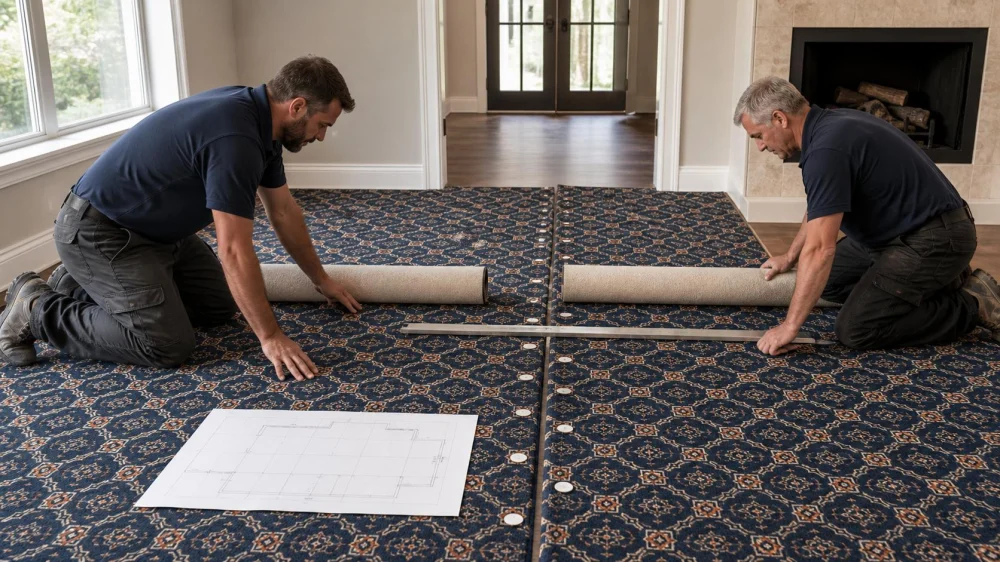
Patterned Carpet Installation: Confirm Repeat, Match, Bow, Skew, and Waste
On this page
Quick answer
Patterned carpet requires more than room area. Confirm the pattern repeat in both length and width, roll width and direction, dye lot, pattern orientation, seam locations, starting reference, and extra material needed to align motifs. Ask how the installer will handle bow, skew, elongation, and variation within manufacturer tolerances.
Approve a scaled layout before the roll is cut. The design should align at major sightlines, doorways, stairs, corridors, and seams—not just along one wall.
Mike's Flooring and Design Center
Fenwick IslandSussex CountyDelaware
Ocean Bay Plaza, 1300 Coastal Hwy #8, Fenwick Island, DE 19944, USA
Read the pattern repeat
The repeat is the distance before a motif begins again. It may repeat along the roll, across it, or both. A small geometric repeat may need less matching allowance than a large medallion or directional stripe, but every seam and room transition can add material.
Ask the retailer to identify pattern-repeat dimensions from current product documentation and verify them on the delivered roll. Confirm whether the pattern is drop, set, half-drop, random, or another match. Do not estimate from a small sample, which may omit the full motif.

Plan seams and visual alignment
- Draw every room, alcove, closet, doorway, stair, and transition.
- Mark the main viewing direction and natural-light direction.
- Choose the pattern orientation relative to walls, halls, and furniture.
- Place seams away from focal sightlines and pivot traffic when practical.
- Continue motifs deliberately through connected openings.
- Decide which architectural reference wins when walls are not square.
- Calculate match allowance for every adjacent breadth and cut.
- Reserve attic stock from the same roll for future repair.
A centered motif may require different waste than a layout beginning at one edge. Ask to see both options when symmetry matters.
Discuss bow, skew, and tolerance
Bow means pattern rows curve across the width; skew means they run diagonally rather than square to the carpet edge. Pattern elongation and variation can occur along the roll. These conditions affect how precisely motifs meet at seams and walls.
Ask who inspects and documents the roll, which manufacturer tolerance applies, what correction methods the installer expects to use, and when work should stop for supplier review. Pattern matching can require stretching and adjustment by a trained installer, but it cannot make every imperfect wall or manufactured motif mathematically identical.
Inspect before cutting and after installation
Before cutting, unroll enough material under suitable light to check product, color, orientation, repeat, visible defects, bow, skew, and damage. Compare labels on all rolls. Photograph the full-width pattern with a straight reference and get written approval for any known variation.
After installation, view from normal standing positions and major entrances. Check motif continuity, seam alignment, edge cuts, transitions, stairs, and the relationship to walls. Inspect under daylight and room lighting, then record accepted conditions and leftover material.
Pattern checklist
- Full repeat measured lengthwise and crosswise
- Roll width, direction, dye lot, and labels verified
- Scaled seam and orientation plan approved
- Focal line and centering decision recorded
- Match allowance included in quantity
- Bow, skew, elongation, and tolerances discussed
- Roll inspected before cutting
- Installed pattern reviewed from key viewpoints
- Same-roll attic stock labeled and stored
Limitations
This guide cannot calculate a project’s exact quantity or judge manufacturing tolerance. Pattern, room geometry, roll size, seam method, installer technique, substrate, and manufacturer instructions vary. Use a qualified patterned-carpet estimator and installer.
FAQ
Why does patterned carpet create more waste?
Adjacent pieces may need to shift forward until motifs align, and centering or continuity can require additional cuts.
Can the pattern align with every wall?
Not when the room itself is out of square. Agree on the dominant visual reference.
Should I order extra?
Yes, but the amount must come from a layout using the actual repeat, roll, rooms, seams, and future repair needs.
Is a small sample enough to plan?
No. It may not show the full repeat, manufacturing variation, or room-scale effect.
When should installation stop?
Stop before cutting further when product, dye lot, damage, or pattern variation conflicts with approved specifications or tolerances.
Evidence notes
Project evidence should include product specifications, roll and dye-lot labels, repeat measurements, scaled layout, quantity calculation, pre-cut inspection photos, manufacturer tolerances, approved variation notes, final seam photos, and attic-stock label. These records connect visual expectations to delivered material.
Conclusion
Patterned carpet succeeds when alignment is designed before cutting. Measure the full repeat, choose the visual reference, map every seam, budget match waste, document roll variation, and inspect key sightlines. The drawing is as important as the carpet.


 Ollie's Bargain Outlet4.0 (800 reviews)
 Godoy Flooring Services4.0 (37 reviews)
 HomeGoods4.0 (103 reviews)
 SUMMIT RUG4.0 (14 reviews)
 Allied Carpet4.0 (5 reviews)
 Red Carpet Runner5.0 (5 reviews)
 Best Carpet for Humid Climates: What Works and What Doesn’t
 How to Choose the Best Carpet for High‑Traffic Spaces
 Best Carpet Materials for Maintaining Comfort and Warmth in Winter | CarpetHub
 Why Wool Carpets Are a Good Choice for Your Home
 How to Clean Your Carpet After a Party: A Step-by-Step Guide
 How to Choose the Right Carpet for a Family Room or Entertainment Space