
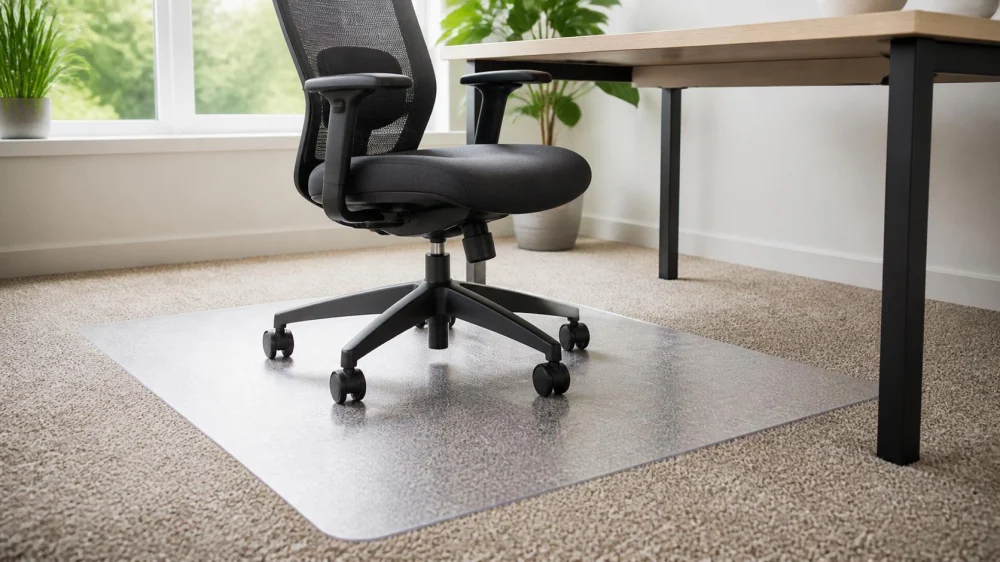
Rolling Office Chair on Carpet: Protect Pile, Seams, and Subfloor
On this page
Quick answer
Repeated rolling in a small desk area can crush pile, stress backing, work across seams, and transfer concentrated loads to the cushion and subfloor. Check the carpet warranty and installation type, then use a chair mat specifically rated for that carpet's pile and the combined chair-and-user load. Keep the mat flat, stable, large enough for the full rolling path, and clear of curled edges.
Inspect the casters for grit, sharp edges, damage, and free rotation. A mat reduces direct wear but does not fix loose carpet, a failing seam, an unsuitable cushion, or a damaged subfloor.
Dimauro Carpet Tile
East LongmeadowHampden CountyMassachusetts
185 Shaker Rd, East Longmeadow, MA 01028, USA
Why chair wheels concentrate wear
A desk chair travels the same short path many times per day. Small wheels concentrate force and can twist yarn, flatten pile, flex seams, and pump a soft carpet-and-pad system. Dirt caught in the caster surface adds abrasion.
The Carpet and Rug Institute's commercial maintenance guidance notes that the area under a desk should be protected because chair rollers create concentrated wear even though the area may appear to have low foot traffic.

Identify the carpet system
Find the carpet product, pile height, construction, backing, cushion, installation method, and warranty. A low, dense glue-down commercial carpet behaves differently from plush residential carpet over thick pad. Note the locations of seams, transitions, floor vents, access panels, thresholds, and radiant-floor components.
If the carpet is loose, buckled, damp, delaminating, or already separating at a seam, stop rolling over it and ask the installer or retailer to assess the cause before adding a mat.
Choose a compatible chair mat
Use a mat sold for carpet, not a smooth-floor mat. Match its underside and thickness rating to the actual pile and cushion, and verify the stated load capacity. A mat that is too thin can cup or crack; the wrong underside may shift, mark the carpet, or fail to anchor properly.
- Measure the chair's full movement, not only the desk opening.
- Keep every caster on the mat during normal work.
- Choose a shape that does not overlap a seam or transition when possible.
- Check that edges lie flat and do not create a trip hazard.
- Ask whether mat materials or cleats affect the carpet warranty.
Inspect the chair and casters
Turn the empty chair over safely or follow the chair maker's service instructions. Remove hair and grit, confirm each wheel rotates and swivels freely, and look for cracks, flat spots, sharp molding seams, or missing parts. Replace only with casters approved for the chair's stem, load, and intended surface.
Soft-tread wheels marketed for other floor types are not automatically safe on every carpet. Wider wheels may spread load, but compatibility still depends on the chair, mat, carpet, and user.
Place the workstation deliberately
Position the chair path away from carpet seams and carpet-to-hard-floor transitions when the room allows. Keep the chair from striking baseboards, floor outlets, heater covers, or glass doors. Arrange cables above or beside the rolling area so casters cannot cut, trap, or unplug them.
Confirm that the mat and furniture preserve a clear walking path and do not block doors or accessible circulation. Never stack improvised boards or several mats in a way that can slide or create abrupt edges.
Clean and inspect the protected area
Vacuum the exposed carpet and clean the casters regularly. On a schedule permitted by the mat and carpet makers, lift the mat with help if needed, inspect underneath, remove dry soil, and allow any cleaned carpet to dry fully before replacing it.
Check for trapped moisture, discoloration, cracked mat edges, cupping, deep depressions, seam stress, and pile change. Repositioning the desk slightly may distribute wear only when it does not create a new hazard or conflict with the room layout.
Warning signs to address
Stop using the rolling area if the mat slides, curls, cracks, develops sharp edges, or sinks enough to trap wheels. Also stop if the carpet ripples, a seam opens, the backing separates, the floor feels soft, or a caster repeatedly catches.
Contact the mat maker for product failure, the chair maker for caster or stability problems, and the carpet retailer or qualified installer for flooring movement or damage. Document the area before moving components if a warranty claim may follow.
Home-office checklist
- Carpet product, pile, cushion, and warranty identified.
- Chair-and-user load considered.
- Mat is rated for carpet type and full rolling path.
- Edges lie flat and the mat does not shift.
- Casters are clean, intact, compatible, and free-turning.
- Seams, transitions, and cables stay outside the rolling path.
- Area under the mat is inspected periodically.
Important limitations
This is general U.S. home-office flooring guidance, not structural, accessibility, ergonomic, or warranty advice. Carpet, cushion, installation, subfloor, chair, casters, mat materials, loads, and manufacturer requirements vary. Follow each current product instruction and obtain professional assessment for movement, moisture, or substrate damage.
Evidence notes
CRI maintenance guidance identifies concentrated roller wear beneath desks and recommends chair-mat protection. CRI installation materials also distinguish carpet systems suited to rolling traffic, while Shaw preventive-care guidance warns that rollers or casters can damage carpet without a carpet-specific chair pad. Together, these sources support protecting the full chair path and checking the entire carpet system.
FAQ
Can I use a hard-floor chair mat on carpet?
Usually not; choose a mat specifically rated for the carpet pile and cushion.
How large should the mat be?
It should keep all casters supported throughout the normal rolling path.
Can a chair mat damage carpet?
An incompatible, cracked, shifting, or poorly rated mat can create problems.
Should the mat cover a carpet seam?
Avoid repeated rolling across seams when possible and ask the installer about unavoidable layouts.
Are rollerblade-style casters safe for carpet?
Not automatically; verify chair, load, mat, and carpet compatibility.
Why is the mat sinking?
It may be too thin or under-rated, or the carpet, cushion, or subfloor may be too soft or damaged.
Next steps
Measure the full chair path, identify the carpet and cushion, inspect every caster, and compare the warranty with the mat specification. Install only a compatible mat that lies flat, then schedule regular cleaning and under-mat checks.



 Homestead Carpets Inc4.0 (10 reviews)
 Michaels4.0 (751 reviews)
 Manhattan Royal Carpet and Floors5.0 (11 reviews)
 Kirkland's Home4.0 (239 reviews)
 Aubuchon Ace Hardware4.0 (109 reviews)
 Molyneaux Home4.0 (119 reviews)
 How to Deal with Carpet Mats and Bunching After Installation
 The Top Benefits of Carpet in Your Home | Comfort, Style, and Functionality
 Best Carpet Brands for Budget-Friendly Homes: Affordable Options for Every Home
 How Texture and Weave Can Add Depth to Your Floors
 The Best Carpet for Homes with High Foot Traffic
 Earthy Tones in Carpet Design: What’s Hot Right Now