
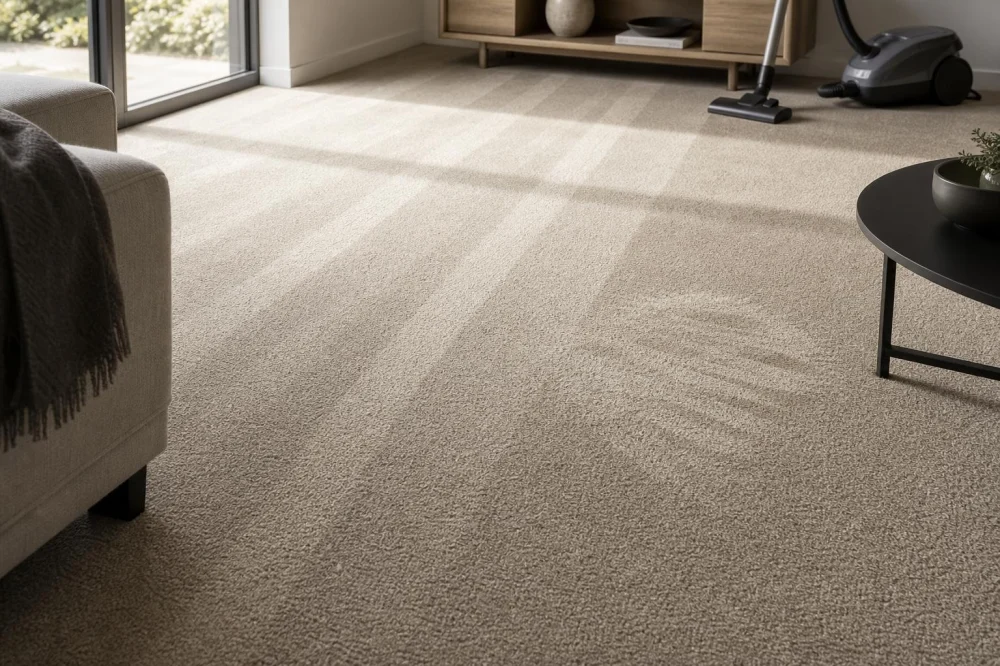
Why Carpet Looks Lighter or Darker From Different Angles
In this guide
A carpet can appear pale from one doorway and deep in color from the opposite wall even when every fiber was dyed the same. Cut-pile fibers reflect light differently depending on whether they lean toward or away from the viewer. Footsteps, vacuuming, installation direction, windows, and traffic can all change that orientation. Some variation is normal; abrupt or persistent differences deserve a closer look.

Schenectady Floor Covering
SchenectadySchenectady CountyNew York
1910 Maxon Rd Extension, Schenectady, NY 12308, USA
Quick answer
View the area from both directions and under daylight and evening light. Gently brush the pile with your hand or vacuum adjacent areas in one consistent direction. If the contrast reverses as you move, it is probably related to pile and light. If a boundary stays sharply different, the color never blends, fibers feel different, or damage is visible, photograph it and ask the retailer or installer to inspect before cleaning or altering the carpet.
How pile direction changes reflected light
Carpet pile is made of yarn tufts that stand, loop, twist, or lean. In a cut-pile carpet, the sides and tips of fibers reflect light differently. Fibers leaning toward the observer may look darker or lighter than those leaning away, depending on yarn shape, luster, color, and the light source.
This optical effect can be strongest in smooth plush, saxony, and velvet-like constructions where the surface is uniform enough to show every change. Textured, heathered, looped, patterned, or multicolor carpets may disguise direction more effectively, but none is completely independent of light.
Turn a carpet sample 180 degrees under the same lamp. If its color appears to change, the dye did not change—the viewing relationship did.
Vacuum marks and footprints
A vacuum head bends fibers into alternating lanes, creating the familiar light-and-dark stripe. A footstep changes the pile on a smaller area. These marks are often temporary and especially visible on dense, smooth cut pile.
If stripes bother you, finish vacuuming the visible room in one direction with overlapping passes. Use a vacuum and height setting suitable for the carpet; excessive brush agitation or a head set too low can fuzz yarn, strain the machine, and create wear.
“Footprint-free” is a marketing description, not an absolute guarantee. Before buying, press and stroke the sample, then view it from several angles to see how readily it records movement.
Shading, pooling, and watermarking
Shading is a visual change caused by pile direction rather than a true color change. A more persistent, irregular form may be called pile reversal, pooling, or watermarking because it can resemble spilled water. The affected pile lies in a different direction and can form curved or island-like shapes.
This appearance may develop without a spill, stain, poor vacuuming, or obvious installation error. Causes can be complex and are not always identifiable after the fact. Some carpet types and interiors make the effect more visible.
Cleaning does not necessarily correct pile reversal because the issue is fiber orientation, not soil. Ask how the manufacturer addresses shading or pooling in its warranty and product literature before purchase.
Why adjoining pieces can look mismatched
Carpet pieces installed with pile running in different directions can appear like different colors. For this reason, installers plan seam layout and pile direction across connected areas. Roll arrows, backing marks, or the way the material unrolls help establish orientation.
Even when direction matches, a seam may be more visible because light strikes the joined edges, yarn is disturbed during installation, or two dye lots differ. A seam is a constructed joint and may not be invisible under every light, but a sharp color-like change should be evaluated.
Do not pull yarns, trim the seam, apply chemicals, or attempt to lift the carpet. Photograph from both ends of the room and contact the installer while installation details are still available.
Room lighting can exaggerate contrast
Low-angle sunlight from a large window reveals texture and casts tiny shadows between tufts. Recessed fixtures, wall washers, lamps, and bright doorways create different highlights. A carpet selected under a store's uniform lighting may look more directional at home.
Paint color, glossy floors, mirrors, and window treatments also affect reflected light. Compare the carpet with blinds open and closed, then under the lamps used at night. Stand at common viewpoints such as the hall entrance, sofa, and stairs.
Lighting changes can reduce the visual emphasis, but they do not repair a material or installation defect. First determine whether the appearance moves with the viewer and light.
Traffic lanes and pile crushing
Repeated walking can compress and reorient pile, making a path look darker, lighter, flatter, or duller. Soil can add another color change, especially where oily residue attracts particles. Furniture feet create concentrated depressions.
Regular vacuuming appropriate to the carpet, entry mats, prompt spot care, and periodic professional cleaning can manage soil and help maintain appearance. Rotate movable furniture and traffic patterns when practical. Furniture cups can spread weight, but selection depends on the furniture and carpet.
Not all crushing is reversible. Yarn fiber, twist, density, cushion, traffic, maintenance, and time influence resilience. A warranty may distinguish normal appearance change from covered performance failure.
Evaluate appearance before buying
Borrow the largest sample available and place it flat in the actual room. View it morning, afternoon, and night, then rotate it. Walk on it, brush it, and make a vacuum-like pass with your hand. A small upright swatch in a showroom cannot show the whole effect.
Ask the retailer about pile direction, shading, footprints, vacuum marks, seam visibility, dye lots, and manufacturer exclusions. Request written product and warranty documents rather than relying on a casual promise that the carpet “never shows marks.”
For connected rooms, stairs, or a large open plan, discuss roll width and layout. A direction chosen for the main room may affect a hallway or landing.
Document the carpet after installation
Before moving furniture in, photograph every room from opposite directions in natural and artificial light. Include seams, transitions, stairs, thresholds, and leftover roll labels. Save the invoice, product name, color, dye-lot information, cushion details, floor plan, and warranty.
Walk the space with the installer. Ask about any abrupt shade line, reversed section, visible seam, wrinkle, loose edge, or damaged tuft. Note concerns on completion paperwork rather than waiting until the installation history is unclear.
Keep a useful remnant in a clean, dry location. It can help identify the material and provide a comparison, though a stored piece will not experience the same traffic and light as installed carpet.
When to request a professional inspection
Request an inspection when the difference remains from every viewpoint, follows the boundary of a carpet piece, appears immediately as a strong mismatch, includes different texture or pile height, or is accompanied by loose seams, ripples, delamination, odor, staining, or moisture.
Contact the seller or installer first and follow the warranty's notice process. Provide wide-room photos from both directions, close-ups, dates, cleaning history, and product documents. The retailer may involve the manufacturer or an independent carpet inspector.
If the change appears after water intrusion, plumbing failure, or persistent dampness, address the moisture source promptly. Staining, microbial growth, and backing damage are separate from ordinary optical shading.
Frequently asked questions
Why does my new carpet look like two colors?
Pile direction and lighting are common reasons, especially near a seam or doorway. View from both ends and ask the installer if the boundary remains sharp.
Will vacuum lines go away?
They usually change with walking or the next vacuum pass. Dense smooth pile tends to show them more.
Is shading a stain?
Not necessarily. Optical shading changes with direction; a stain reflects soil, liquid, dye change, or damage. Persistent uncertainty warrants inspection.
Can professional cleaning fix pooling?
Cleaning can remove soil but may not correct pile reversal. Ask a qualified carpet professional before purchasing a treatment.
Does darker carpet hide direction changes?
Color alone does not decide it. Construction, yarn luster, texture, pattern, room light, and contrast all influence visibility.
Judge the fibers, direction, and light together
Apparent color change is often the combined effect of pile orientation and light, not a dye failure. Test the view, rotate samples before purchase, vacuum consistently, and document installation. When a fixed boundary, texture difference, damage, or moisture accompanies the contrast, stop experimenting and request a professional assessment while records and warranty options are available.



 Hall Distributors LLC4.0 (12 reviews)
 Aronson's Floor Covering4.0 (31 reviews)
 Raymour & Flanigan Furniture and Mattress Store4.0 (2998 reviews)
 ARD Tile Carpet & Vinyl Co Inc.5.0 (3 reviews)
 Miller's Furniture-Carpet Otlt3.0 (34 reviews)
 Arshs Fine Rugs (Saturday By Appointment)5.0 (7 reviews)
 How Carpet Adds Comfort and Warmth to Your Home
 Carpet Care Essentials Every Homeowner Needs
 How to Choose the Right Carpet Color for a Cozy and Inviting Home
 Carpet Care Essentials Every Homeowner Should Know
 Is Carpet Still a Good Investment for Your Home? | CarpetHub
 What Are the Top Carpet Trends for 2025?