
Carpet Wet After Cleaning: Dry, Ventilate, and Recheck
On this page
- Quick answer
- Separate expected dampness from a problem
- Record the cleaning and drying timeline
- Create safe airflow and dehumidification
- Check carpet, backing, pad, and floor
- Protect people, pets, and furniture
- Track odor, spots, and texture changes
- Contact the cleaning company promptly
- Know when restoration help is needed
- Preserve records for a claim
- Drying checklist
- Official moisture guidance
- Conclusion and next steps
Quick answer
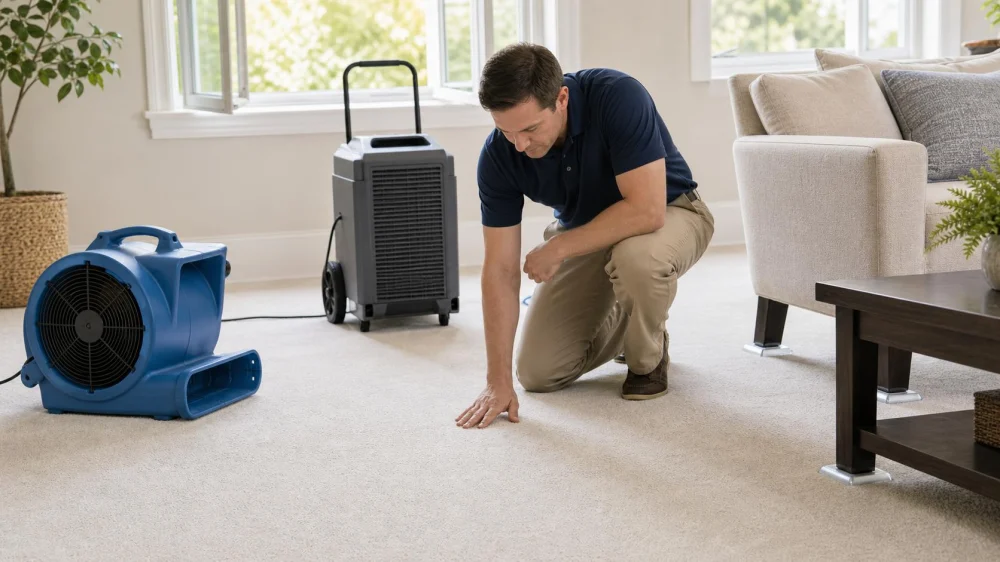
After professional or rental-machine carpet cleaning, follow the stated drying time, keep people and pets off damp areas, run fans and dehumidification, and monitor both the surface and lower layers. Record when cleaning ended, ventilation started, and each area became dry. If carpet remains wet, develops a musty odor, stains reappear, padding feels saturated, or water reached walls or cabinets, contact the cleaner or a water-restoration professional promptly. Wet carpet and backing should be dried quickly, ideally within 24–48 hours.
Drying time varies with water amount, extraction, fiber, pad, room humidity, temperature, and airflow. A dry-feeling surface does not prove the backing and pad are dry.
Separate expected dampness from a problem
Ask the cleaner what method was used, how much moisture remains, and the expected drying window for that room. Hot-water extraction, low-moisture cleaning, spot treatment, and flood restoration are different services.
Uniform slight dampness that steadily decreases may be expected. Puddles, squishing, water moving into adjacent flooring, soaked baseboards, or no drying progress need faster attention.
Do not add household chemicals, fragrance, powder, or another cleaning pass while the carpet is still wet unless the contractor directs it.
David Hockstein Inc
Capitol HeightsPrince George's CountyMaryland
8600 Ashwood Dr, Capitol Heights, MD 20743, USA
Record the cleaning and drying timeline
Write down the service finish time, room temperature and humidity if known, doors and windows used, fans or dehumidifiers started, and when furniture was moved.
Take timestamped photos of each room and any wet edge, stain, ripple, seam, or furniture mark. Repeat from the same angles as drying progresses.
EPA and CDC guidance emphasizes drying wet materials within roughly 24–48 hours to reduce mold risk. Treat that as a prompt-action window, not a guarantee that every carpet can be saved.
Create safe airflow and dehumidification
Follow the cleaning company's ventilation plan. Use fans to move air across the carpet and a dehumidifier or air conditioner to remove moisture when outdoor air is humid.
Open windows only when weather and security make it safe and outside air will help. Avoid pointing unprotected equipment where children or pets can touch cords or blades.
Do not use an unvented fuel-burning heater or improvised high heat. Heat can create fire, fume, shrinkage, adhesive, and indoor-air hazards.
Check carpet, backing, pad, and floor
Carpet is a layered system. The pile may feel dry while the primary backing, cushion, tack strip, subfloor, or concrete remains damp.
EPA guidance for wet carpet describes water extraction and, when necessary, lifting carpet and pad so air can reach them. That work should be done by someone who can reinstall the system safely.
Do not pull carpet from tack strips barefoot or without training. Sharp fasteners, contaminated water, heavy materials, and hidden electrical sources can make inspection hazardous.
Protect people, pets, and furniture
Block access until the carpet is dry enough under the cleaner's instructions. Damp carpet can be slippery at transitions and can transfer cleaner or soil to feet and paws.
Keep furniture on protective tabs or blocks until approved for removal. Wood, metal, dye, or finish placed against damp carpet can leave stains or rust.
Ventilate according to product directions and the needs of asthma, allergy, chemical sensitivity, children, older adults, and pets. Seek medical advice for concerning symptoms.
Track odor, spots, and texture changes
A strong cleaner scent should decrease as ventilation and drying continue. A new persistent musty or earthy odor can signal hidden dampness and deserves investigation.
Dark spots that return may be wicking from deeper soil, padding, a spill, or excess moisture. Photograph the change before applying anything.
Ripples can sometimes relax as drying completes, but buckling that persists creates a trip risk. Keep the area blocked and ask the cleaner or installer to assess it.
Contact the cleaning company promptly
Report the room, finish time, current dampness, odor, temperature, humidity, equipment used, and photos. Ask for a written response and a time for reinspection.
Clarify whether the company will re-extract water, add drying equipment, lift the carpet, inspect the pad, treat a spot, or refer a restoration specialist.
Do not authorize another wet pass without understanding why it is needed and how the new moisture will be removed.
Know when restoration help is needed
Seek qualified water-damage help for saturated padding, water from sewage or flooding, affected drywall or cabinets, electrical concerns, large areas, or materials still wet near the 24–48-hour window.
Visible mold or a strong musty odor requires moisture-source correction and appropriate remediation, not simply deodorizer or surface shampoo.
People with health concerns should avoid disturbing moldy material and follow public-health advice. Testing is not always the first or most useful step; visual inspection and moisture investigation matter.
Preserve records for a claim
Save the estimate, invoice, cleaner's method, product list, warranty, before-and-after photos, humidity readings, communications, and equipment-rental receipts.
If a leak or building defect contributed, document the source and repairs. Notify the property owner, manager, or insurer within applicable deadlines without admitting fault.
Keep damaged samples only when a professional or insurer requests them and they can be stored safely.
Drying checklist
- Cleaning method, finish time, and expected drying time recorded
- Safe cross-ventilation, fans, and dehumidification running
- Surface, backing, pad, edges, walls, and adjacent floors checked
- People and pets kept off damp areas
- Furniture protected from direct carpet contact
- Photos and humidity readings tracked over time
- Musty odor, wicking, ripples, and slow drying reported promptly
- Professional help arranged for saturation or contaminated water
Official moisture guidance
The EPA explains how extraction, lifting carpet and pad, fans, and dehumidifiers can help dry carpet and backing within 48 hours in Mold Course Chapter 4.
Its moisture investigation chapter notes that backing and padding must also dry and that hidden moisture should be evaluated.
CDC/NIOSH recommends drying wet materials within 48 hours or removing them and prioritizes visual and odor investigation; see mold testing and remediation guidance.
Conclusion and next steps
Wet carpet after cleaning needs measured drying, not guesswork. Establish the timeline, move air safely, reduce humidity, protect the room, and verify lower layers rather than touching only the pile. Contact the cleaner at the first sign of stalled drying or new odor, and escalate quickly when water is contaminated, widespread, or still present near the 24–48-hour window.


 GoldenNile0.0 (0 reviews)
 Leon Banilivi Rugs,Inc4.0 (7 reviews)
 Direct Line Carpeting4.0 (2 reviews)
 Family Carpets of New Jersey3.0 (5 reviews)
 General Floor - Holmes4.0 (48 reviews)
 KASTHALL5.0 (2 reviews)
 How to Protect Your Carpet from Dirt and Dust in Your Entryway
 How to Get Rid of Carpet Odors Fast: Proven Methods That Work
 How to Find a Local Carpet Installer You Can Trust
 Carpet Care Essentials Every Homeowner Needs
 How to Choose Carpet That Fits Your Budget and Style
 How to Tackle Common Carpet Problems: Fading, Wrinkles, and Wear in 2026