
What to Do With Leftover Carpet After Installation
On this page
- Quick answer
- Why a repair remnant matters
- Select the best piece to keep
- Store carpet without damaging it
- Practical ways to reuse leftovers
- Donate, recycle, or dispose
- Questions for the installer
- Leftover carpet checklist
- Limitations and important notes
- Frequently asked questions
- Sources and evidence notes
- Next steps
Quick answer
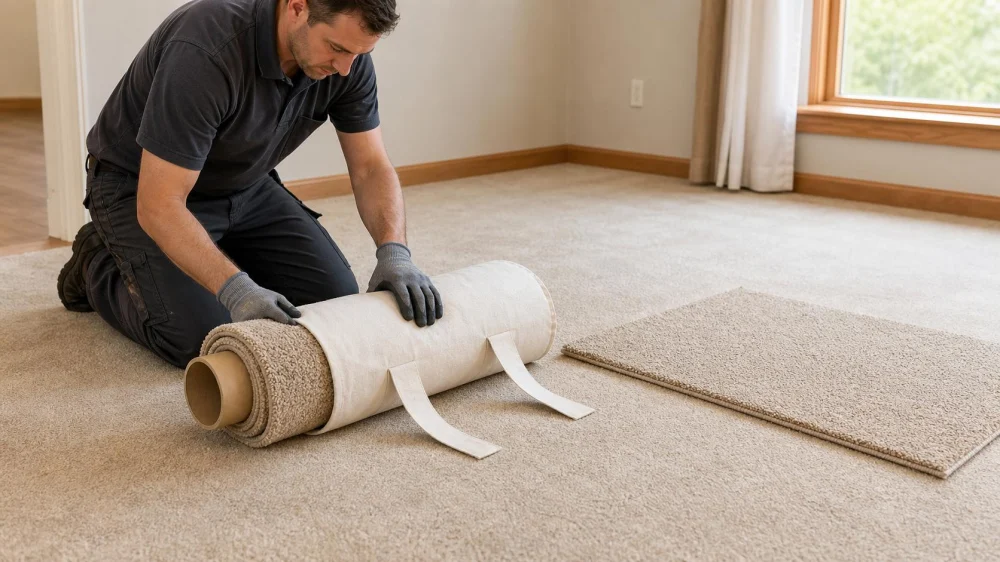
Keep one clean, useful carpet remnant from the same installation for future repairs. Mark the room, product, installation date, pile direction, and dye-lot information when available, then roll it face-in around a wide core and store it dry, supported, and away from pests. Offer larger usable pieces for binding or donation; confirm local recycling rules before transporting scraps.
This guide is for US homeowners managing ordinary post-installation carpet leftovers. Ownership, removal, recycling, and disposal terms should be confirmed in the installation agreement.

Why a repair remnant matters
A matching remnant can help a carpet professional replace a permanently stained, burned, or damaged section later. Carpet color, texture, backing, and pile can change between products and production runs, so buying a close match years later may not produce a convincing repair.
The stored piece will not age under sunlight and foot traffic like the installed carpet. A new patch may initially look different even when it came from the same roll. Professional placement and grooming can improve the result, but a perfect invisible repair is not guaranteed.
Keep enough material for a meaningful repair without storing every narrow strip. A square or rectangular piece is easier to handle than many irregular offcuts.

Select the best piece to keep
Ask the installer to set aside a clean piece before scraps touch the driveway, dumpster, wet floor, adhesive, or construction debris. Choose material that includes full backing and undamaged face fibers.
Prefer a piece wide enough to extend beyond a likely small repair. Avoid narrow strips with crushed edges, seam sealer, tack-strip holes, or cuts through the backing. For patterned carpet, keep a section that includes at least one complete useful motif repeat when possible.
Record:
- Room or floor where the carpet was installed.
- Manufacturer, style, color, and product number from the invoice.
- Dye lot or production information when provided.
- Installation date and installer contact.
- Pile or pattern direction relative to the room.
Put the information in a sealed sleeve attached to the outside wrapping rather than writing directly on the carpet face.
Store carpet without damaging it
- Make sure it is dry. Never wrap carpet that is damp from cleaning, weather, or installation conditions.
- Vacuum loose debris. Use an appropriate setting and avoid damaging the edges.
- Roll rather than fold. A roll reduces sharp creases in the backing. Keep the face inward for protection unless the product instructions say otherwise.
- Use a wide core. A sturdy tube can prevent a tight curl. Do not use a dirty or chemically contaminated core.
- Wrap with breathable protection. Keep dust and pests out without trapping moisture. Avoid an airtight plastic wrap if the material or space may contain humidity.
- Support the roll. Store it horizontally with support along its length or upright only when stable and allowed by the product guidance.
- Keep it conditioned. A dry interior closet or similar space is generally better than a damp basement, hot attic, outdoor shed, or garage subject to leaks and pests.
Do not place heavy boxes on the roll. Inspect the storage area periodically for moisture, insects, rodents, odor, or crushing.
Practical ways to reuse leftovers
Professional repair stock
This is usually the highest-value use for a matching piece. Keep it intact until a carpet-repair professional confirms how much a future repair requires.
Bound mats or runners
A carpet shop may be able to cut and bind a larger remnant into a finished mat or runner. Binding helps control fraying and creates a cleaner edge. Add a compatible non-slip backing or pad suited to the floor beneath.
Closet or small-area use
A substantial piece may fit a closet or protected utility area, but it still needs proper edge treatment and installation. Loose carpet on stairs or an unsecured slippery floor is not a safe shortcut.
Furniture and craft protection
Small pieces can protect surfaces during moving or become workshop pads, but verify that fibers will not transfer color or scratch the surface. Keep pieces away from open flame, heaters, and tools that create sparks.
Avoid using ordinary carpet as an exterior doormat, pet-chew item, vehicle pedal mat, or improvised stair tread. Moisture, loose fibers, movement, and interference with controls can create hazards.
Donate, recycle, or dispose
Donation centers, schools, theaters, animal organizations, makerspaces, and reuse stores have different policies. Call before loading the material. Describe size, backing, condition, smoke or pet exposure, and whether edges are finished.
Carpet recycling availability varies by material and location. A recycler may accept only certain fiber types, commercial quantities, separated padding, or material free of adhesive and contamination. Ask the installer, retailer, local solid-waste agency, or a specialized carpet recycler about current requirements.
Separate carpet from padding and other construction debris only when instructed. Do not leave rolls beside a donation bin or recycling container without approval. If disposal is required, follow local size, bundling, pickup, and landfill rules.
Questions for the installer
- Do the leftovers belong to the homeowner or remain with the installer?
- Can you cut one clean rectangular repair remnant?
- Which direction does the pile or pattern run?
- Can you provide the product and dye-lot information?
- Will you remove scraps, padding, tubes, and packaging?
- Do you offer binding or know a local service?
- Does the retailer or installer participate in a recycling program?
- Are disposal or haul-away fees already included?
Leftover carpet checklist
- One clean, full-backed repair piece is selected.
- Room, product, color, lot, date, and pile direction are recorded.
- The remnant is completely dry before wrapping.
- It is rolled without a sharp fold and protected from dust.
- The storage space is dry, conditioned, and pest-free.
- No heavy objects crush the roll.
- Reuse pieces receive safe finished edges and non-slip support.
- Donation or recycling acceptance is confirmed in advance.
- Remaining disposal follows local rules and the contract.
Limitations and important notes
Carpet materials, backings, treatments, installation adhesives, and local waste programs differ. A general storage or reuse method may not suit every product. Follow manufacturer instructions and ask the installer when the backing or treatment is unfamiliar.
Carpet removed after water damage, mold, sewage, fire, pests, or chemical contamination is not ordinary reusable material. Avoid handling or donating it without appropriate professional assessment and disposal guidance.
Frequently asked questions
How much leftover carpet should I keep?
There is no universal size. Keep a clean, manageable rectangle large enough for a likely repair, considering pattern repeat and room size. Ask the installer for a practical recommendation.
Can I fold the remnant to save space?
Folding can crease or crack some backings. Rolling around a wide clean core is generally safer when storage permits.
Should the carpet face roll inward or outward?
Face-in can protect fibers, but product construction matters. Follow manufacturer or installer guidance for the specific carpet.
Can carpet scraps go in curbside recycling?
Usually not unless the local program explicitly accepts them. Confirm with the waste provider before placing carpet in any recycling cart.
Can leftover carpet become a rug?
Yes, if the piece is suitable and professionally cut and bound, with a floor-compatible anti-slip solution.
Sources and evidence notes
The recommendations reflect broad carpet-care and material-handling practice: keep matching production material for repairs, avoid moisture and sharp folds, protect pile direction information, finish exposed edges, and verify recycling acceptance.
No universal remnant size, storage material, recycling access, donation acceptance, or repair invisibility is assumed. Product construction, local rules, and professional evaluation control those details.
Next steps
Before the installer leaves, select one clean rectangular remnant and photograph it beside the product invoice. Record the room and pile direction, roll it after confirming it is dry, and choose an interior storage location. Call any donation or recycling outlet before deciding what to do with the remaining pieces.


 Ted's Flooring & Interior Design4.0 (28 reviews)
 Lowe's Home Improvement4.0 (1436 reviews)
 Lowe's Home Improvement4.0 (2156 reviews)
 High Definition Services & Products5.0 (16 reviews)
 Kingston Carpet One Floor & Home4.0 (34 reviews)
 Framingham Carpet Center5.0 (17 reviews)
 How to Care for Your Carpet After Installation
 Why Investing in Carpet Underlayment Will Improve Comfort and Longevity
 How to Incorporate Carpets in Homes with Hardwood Floors
 How Carpet Technology Is Changing the Way We Shop for Flooring
 How to Choose the Best Carpet for Your Home’s Unique Features
 How to Prevent Carpet Damage from Pets and Kids