
New Carpet Odor: Ventilate, Track, and Contact the Retailer
Table of contents
Quick answer
If new carpet has an objectionable odor, increase safe outdoor-air ventilation, follow the carpet, cushion, and adhesive manufacturers’ instructions, and keep the area lightly occupied while you observe conditions. The EPA recommends ventilation during installation and for 48 to 72 hours afterward, weather and building conditions permitting. Contact the retailer if the odor persists, worsens, or seems tied to a defect, moisture, or installation material. Leave the area and seek appropriate medical help for serious symptoms.
Plan before installation
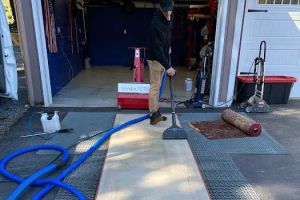
Odor management is easier when it begins before the old floor comes up. Ask the retailer for product names and current technical documents for the carpet, cushion, seam sealer, adhesive, patching compound, and cleaning products. Request emissions information and ask whether lower-emitting options are available. Confirm that each product is appropriate for the substrate and installation method.
The U.S. Environmental Protection Agency advises consumers to ask whether carpet can be unrolled and aired in a clean, well-ventilated location before installation. Discuss this with the seller rather than opening packaged goods outdoors, where they can collect dirt or moisture. Also ask the retailer to require installation according to the manufacturer’s directions and applicable Carpet and Rug Institute guidance.
Schedule work when sensitive occupants and pets can be elsewhere. Plan a secure ventilation method that does not create fall risks, admit rain, compromise security, or pull combustion gases into the home. If the property has fuel-burning equipment, an unusually tight envelope, wildfire smoke outdoors, or complicated mechanical ventilation, ask a qualified HVAC or indoor-air professional how to ventilate safely.

Manage the first days
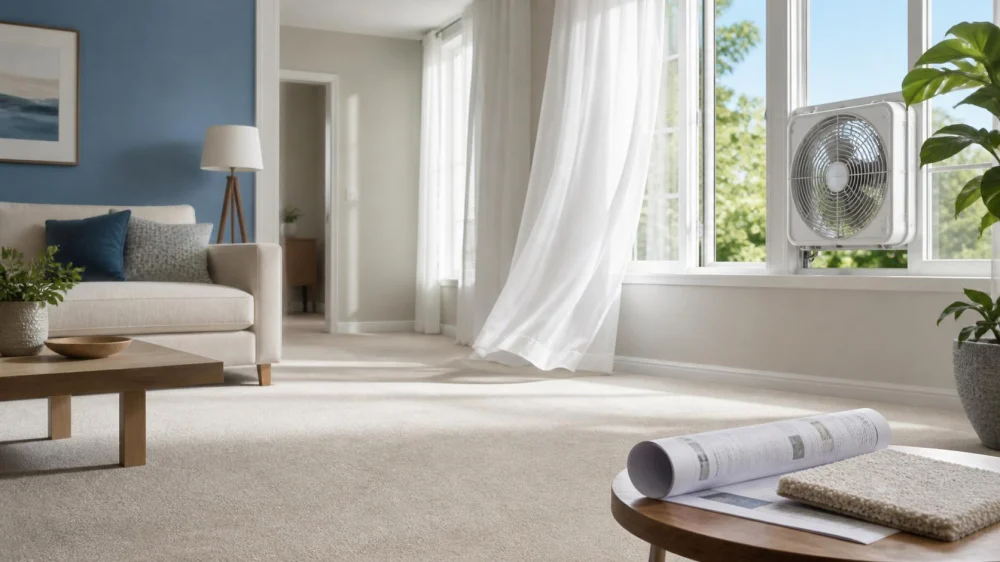
During and after installation, use outdoor air to dilute indoor emissions when conditions allow. EPA guidance suggests opening doors and windows and using fans, room air conditioners with an outdoor-air setting, or other mechanical ventilation to exhaust air outdoors. It specifically recommends operating ventilation during installation and for 48 to 72 hours afterward. Do not treat that time as a guarantee that every odor will disappear; it is a practical ventilation window, not a diagnostic test.
Position portable fans so they move indoor air toward a safe exterior opening, not from a garage, crawlspace, dusty work zone, or chemical storage area into living space. Keep cords away from walkways. Maintain reasonable temperature and humidity according to product instructions, because very damp conditions can create a separate moisture problem.
Vacuum only when the installer says the surface is ready, using a setting suitable for the carpet. Remove installation scraps, adhesive containers, packaging, and protective films from the occupied area. If walls were painted, cabinets installed, or floors refinished at the same time, ventilate for the combined project and keep a record of every material used.
Separate carpet odor from other sources
A “new room” smell does not identify its source. Carpet face fiber, backing, cushion, adhesive, seam products, paint, composite wood, cleaning chemicals, packaging, and old material exposed during removal can all contribute. Odor strength alone does not measure indoor-air safety, and a lack of odor does not prove that air is free of pollutants.
Walk through the project with the installer before furniture returns. Note where odor is strongest, whether the floor feels damp, and whether there are stains, adhesive transfer, loose seams, or wet building materials. Do not lift newly installed carpet or pull at seams to investigate; that can damage the work and affect the warranty. Instead, describe the location and ask the installer or retailer to inspect it.
If odor grows stronger near a plumbing leak, exterior wall, slab, or HVAC register, investigate that condition as its own source. EPA school guidance notes that damp carpet can support microbial growth. Water intrusion requires prompt moisture control and professional assessment; fragrance or ventilation alone does not correct wet materials.
Respond to symptoms carefully
Some people report eye, nose, or throat irritation, headache, cough, shortness of breath, skin irritation, or fatigue around new carpet installations. Those symptoms can have many causes, and this guide cannot determine whether the carpet is responsible. Move the affected person to fresh air when safe, stop unnecessary exposure, and contact an appropriate healthcare professional or poison-control resource for individualized advice.
Call emergency services for severe breathing difficulty, loss of consciousness, confusion, chest pain, or another medical emergency. Keep product labels and safety data available for responders. Do not ask a symptomatic person to re-enter the space merely to test whether the odor triggers the problem again.
People with asthma, chemical sensitivities, pregnancy-related concerns, or other health conditions should follow their clinician’s guidance. A contractor or retailer can investigate materials and installation, but cannot diagnose a health response.
Know when to contact the retailer
EPA guidance says to contact the carpet retailer if objectionable odors persist. Contact sooner if the smell is intense, worsening, localized near an apparent spill, accompanied by visible moisture or product damage, or different from what the installer described. Also call if the installer used an unlisted product, the wrong adhesive appears to have been supplied, or required ventilation instructions were not followed.
Send a concise written notice with the installation date, product and lot information, room, odor timeline, ventilation steps, photos of visible concerns, and any relevant moisture event. Ask who will inspect, what documents they need, and whether you should change cleaning or occupancy while the claim is reviewed. Follow warranty notice deadlines.
During an inspection, ask the representative to identify each installed layer and look for moisture, contamination, improper adhesive use, trapped debris, or another building source. Obtain the findings and proposed remedy in writing. If parties disagree or symptoms continue, an independent qualified indoor-air, flooring, building, or medical professional may be appropriate, depending on the question.
Avoid unapproved odor treatments
Do not apply perfume, powder, disinfectant, solvent, essential oil, oxidizer, or homemade mixture simply to mask the smell. These products can add emissions, leave residue, discolor fiber, affect warranties, or create exposures for people and pets. Never mix cleaners.
Do not use an ozone generator in an occupied home. EPA states that ozone can harm health at concentrations that do not exceed public-health standards and is generally ineffective for controlling indoor air pollution at safe levels. Source control and adequate ventilation are the core strategies; filtration may be a supplement when properly selected, but it does not replace fixing a wet or defective material.
Before professional cleaning a brand-new carpet, obtain written approval from the retailer or manufacturer. Cleaning method, temperature, chemistry, drying, and timing can matter. A recommendation found online for a different fiber or backing may not apply to the installed product.
Build a useful record
Create a simple log with date, time, room temperature and humidity if available, window and fan operation, HVAC setting, outdoor conditions, odor location and intensity, occupancy, and any symptoms. The log does not prove cause, but it helps the retailer see whether conditions are improving and prevents vague recollections from replacing facts.
Keep the contract, invoice, product labels, installation instructions, safety data sheets, warranty, photos, emails, and service reports. Record only factual observations. A sentence such as “odor strongest near the north-wall seam at 8 a.m.” is more useful than an unsupported conclusion about a chemical or health effect.
Frequently asked questions
How long should I ventilate after new carpet installation?
EPA consumer guidance recommends operating ventilation during installation and for 48 to 72 hours afterward. Continue according to product directions and actual conditions, provided ventilation is safe. Persistent objectionable odor should be reported to the retailer.
Does a strong smell prove the air is dangerous?
No. Odor is not a reliable measurement of indoor-air quality or health risk. Use product information, site inspection, appropriate professional advice, and medical guidance for symptoms rather than relying on smell alone.
Should I steam-clean new carpet to remove odor?
Do not do so without checking the manufacturer and retailer. Unapproved cleaning may add moisture or affect a claim. First ventilate, document, and request product-specific instructions.
Can an air purifier replace ventilation?
Not generally. EPA describes source control and ventilation as primary indoor-air strategies, with filtration as a possible supplement. A filter must be selected for the pollutant and used correctly, and it cannot repair wet or defective flooring.
What if the odor began after a leak, not installation?
Treat the moisture event as the priority. Restrict access if needed, stop the water source, document the affected area, and obtain prompt professional assessment. Masking the odor does not dry hidden layers.
Sources and verification
- U.S. EPA, The Inside Story: A Guide to Indoor Air Quality — consumer guidance on new carpet, ventilation, product information, and contacting the retailer.
- U.S. EPA, What can I do to improve indoor air quality in my home? — source control, ventilation, and filtration framework.
- U.S. EPA, Ozone Generators that are Sold as Air Cleaners — official limitations and health cautions.
- The Carpet and Rug Institute, Frequently Asked Questions — industry guidance on ventilation and persistent new-carpet odor.
Verify the current instructions for the exact carpet system and obtain medical or professional building advice when conditions require it.
Conclusion
Handle new-carpet odor with fresh air, product-specific instructions, factual observation, and timely communication. Plan ventilation before installation, distinguish odor from moisture or other renovation sources, and do not add unapproved chemicals. If the condition persists or symptoms occur, step back from exposure and involve the retailer and the appropriate qualified professional.


 Frank's Carpet4.0 (56 reviews)
 Better Carpet Warehouse4.0 (52 reviews)
 HomeGoods4.0 (196 reviews)
 Elite Flooring Supply of Southampton0.0 (0 reviews)
 RFW Floor Covering3.0 (6 reviews)
 Avalon Flooring - Manalapan, NJ4.0 (177 reviews)
 Why Carpet is Still the Best Option for Bedrooms: Comfort, Style, and Durability
 How to Care for Your Carpet During the Winter Season
 Top 10 Carpet Styles Trending in 2025: From Plush to Patterned
 The Pros and Cons of Installing Carpet in Kitchens and Bathrooms
 Can Carpets Improve Your Home’s Indoor Air Quality? | CarpetHub
 Using Carpets to Define Zones in Open Floor Plans