
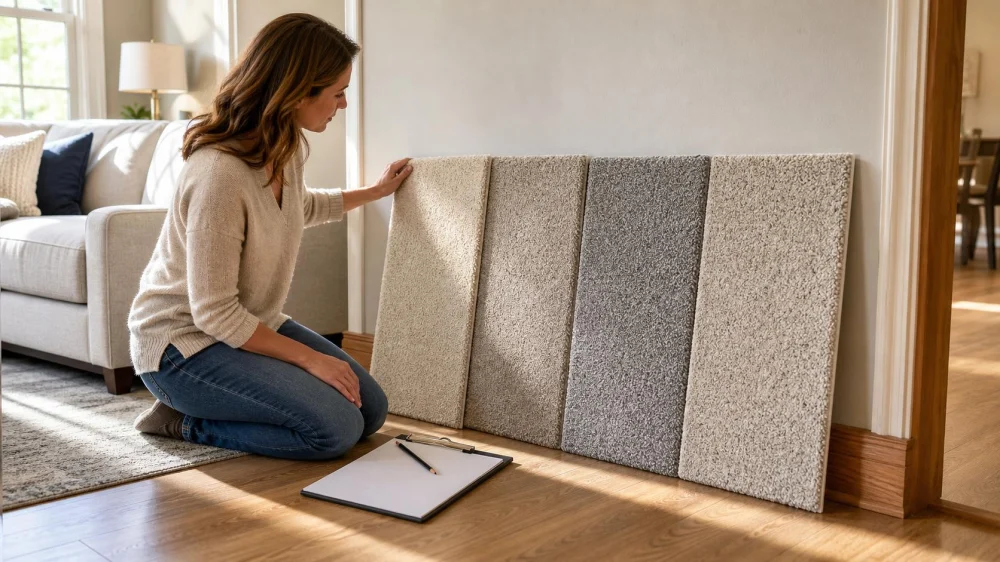
How to Test Carpet Samples at Home Before Buying
On this page
- Quick answer
- What a carpet sample can tell you
- Build a controlled shortlist
- Test every lighting condition
- Evaluate texture and appearance
- Compare in the real room
- Questions the sample cannot answer
- Use a sample scorecard
- Limitations and safety notes
- Frequently asked questions
- Evidence notes
- Conclusion and next steps
Quick answer
Test carpet samples in the actual room for several days. Move them between window light, shade, and evening electric light; view them from standing height and multiple directions; and compare them with walls, trim, furniture, and adjacent floors. Judge color, sheen, pile direction, texture, and visible debris separately. Then verify the exact product, dye lot, warranty, padding, seams, and maintenance requirements before ordering.
An in-home carpet sample test is a controlled comparison of candidate materials under the room's real light, colors, traffic, and viewing angles.
McCarthy Tile Company
AgawamHampden CountyMassachusetts
1140 Springfield St, Feeding Hills, MA 01030, USA
What a carpet sample can tell you
A sample can show how a small piece interacts with the home, but it is not a miniature guarantee of the installed floor. It helps compare color family, contrast, pile character, softness, surface pattern, and how lint or crumbs appear. It cannot fully reproduce a large expanse, seam, stair wrap, directional shading, room acoustics, long-term wear, or the feel of the selected pad.
Request the largest loan sample available. Confirm that its label matches the quote's manufacturer, collection, style, color, and fiber information.

M.C. Weeks, Inc. Window Fashions & Outdoor Living
TrappeMontgomery CountyPennsylvania
183 W Main St, Trappe, PA 19426, USA
Build a controlled shortlist
- Limit the comparison to three or four serious candidates.
- Label each sample with a neutral code if brand or price is biasing the visual test.
- Photograph the official back label before moving it.
- Use the same room locations and observation times for every sample.
- Record impressions before discussing them with other household members.
- Return loan samples in the condition and by the date the store requires.
A controlled comparison is better than carrying one sample around and relying on memory. Keep the candidate size and viewing conditions as consistent as possible.
Test every lighting condition
- Morning: place samples near the window and farther into the room.
- Midday: check bright direct or reflected daylight and shaded corners.
- Evening: use the room's normal lamps and overhead fixtures.
- Cloudy conditions: note whether undertones become cooler, flatter, or darker.
- Multiple directions: rotate each sample 180 degrees because pile direction can change reflected light.
Do not choose from a showroom photo or phone image alone. Cameras, screens, exposure, and white balance can shift color. Keep photos for comparison notes, not color approval.
Evaluate texture and appearance
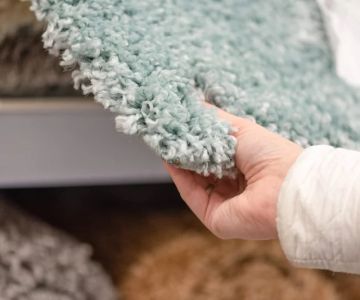
View samples from the doorway, normal seating position, and standing height. Run a clean hand over the pile in different directions and look for changes in sheen or shade. Gently bend the sample only if permitted to observe construction; do not perform destructive tests on a store loan.
- Does the surface show footprints or vacuum marks more than you prefer?
- Are flecks or multiple tones helpful for disguising ordinary debris?
- Does the texture catch furniture legs, wheels, or mobility equipment in a concerning way?
- Will a loop construction suit households with claws, hooks, or snag risks?
- Does the pattern scale make sense when repeated across the entire room?
Softness at the fingers is only one factor. Installed feel also depends on construction, pad, subfloor, and footwear.
Compare in the real room
- Place samples beside the wall, baseboard, main upholstery, woodwork, and adjacent hard floor.
- Move them to the transition where two floors will meet.
- Check high-visibility zones and darker corners.
- Set a clean furniture leg or material swatch beside them without damaging the sample.
- Consider realistic dirt color, pet hair, lint, and cleaning frequency.
- Ask every decision-maker to view the samples independently before voting.
Choose “best for” the actual room, not the sample that looks most dramatic alone. A quiet neutral may support patterned furnishings; a textured multi-tone may be more forgiving in a busy entry to a family room.
Questions the sample cannot answer
- Exact ordered roll width, availability, dye lot, and delivery timing
- Seam position and how directional light may reveal it
- Pattern repeat and additional matching material
- Fiber performance under the household's actual traffic
- Cleaning methods, spot-treatment restrictions, and professional-care requirements
- Pad compatibility, warranty conditions, and installation standards
- Emissions, certifications, allergen claims, or sustainability attributes
- Color variation between a small sample and the delivered production
Ask the retailer for current written specifications and warranty documents. Unsupported adjectives such as “pet-proof,” “stain-proof,” or “hypoallergenic” should not replace defined test data, exclusions, and care instructions.
Use a sample scorecard
Rate each item from 1 to 5 and add notes rather than relying on a total alone:
- Daylight color and evening color
- Compatibility with walls and adjacent flooring
- Texture under normal use
- Directional shading and footprint visibility
- Debris and pet-hair visibility
- Pattern scale and room mood
- Maintenance fit
- Verified product, warranty, availability, and installed total cost
Mark any must-pass failure. A beautiful sample should be rejected if the product cannot meet a required installation, cleaning, accessibility, or budget constraint.
Limitations and safety notes
In-home sampling cannot predict exact color, wear, indoor air effects, or warranty performance. Products and batches vary, and larger installations can look lighter, darker, or more directional than a small piece. Approve the current product and installation plan in writing.
Keep samples flat and out of walkways to prevent trips. Do not wet, stain, burn, scratch, chemically treat, or expose a store's sample to pets unless the retailer explicitly authorizes a test. Follow professional advice for asthma, allergy, chemical sensitivity, or indoor-air concerns.
Frequently asked questions
How long should I keep samples in the room?
Long enough to see the normal range of daylight and electric lighting—often several days—subject to the store's return deadline.
Why does the same sample look like two colors?
Pile direction and reflected light can create apparent shading. Rotate the sample and view it from different directions.
Can I test stains on a carpet sample?
Only on a sample you own and with methods allowed by the manufacturer. Do not damage loan samples or assume one home test proves long-term performance.
Should I choose carpet and pad together?
Yes. Ask which pad is compatible with the exact carpet, installation, warranty, and desired feel.
Does a sample guarantee the delivered color?
No. Confirm current production and dye-lot expectations with the retailer and inspect delivered material according to the purchase terms.
Evidence notes
The method reflects standard design-selection practice: compare identical candidates under real lighting and context, distinguish observed appearance from unverified performance, and confirm written product and installation specifications before purchase. Manufacturer documents and the final delivered material remain authoritative for the selected carpet.
Conclusion and next steps
Borrow three large labeled samples, photograph their official product details, and score them morning, midday, and evening in the actual room. Use CarpetHub to compare stores, then request installed-price quotes, pad specifications, seam diagrams, care instructions, and warranty terms for the strongest candidate. Choose only after both the room test and the written product facts agree.


 B & M Floors Inc.3.0 (11 reviews)
 The Home Depot4.0 (2073 reviews)
 Floor Coverings International of Fall River, MA5.0 (55 reviews)
 The Wood Floor Store2.0 (2 reviews)
 Floor & Decor4.0 (1236 reviews)
 Harbor Freight4.0 (711 reviews)
 What Is Frieze Carpet and Why You Should Consider It for Your Home
 The Ultimate Guide to Choosing Carpet for Your Kitchen
 Simple Ways to Refresh Your Home’s Look with New Carpeting
 How to Match Carpet to Your Home’s Exterior Style and Color
 Stylish Carpet Ideas That Perfectly Complement Modern Decor
 Why You Should Consider Carpets for Commercial and Retail Spaces