
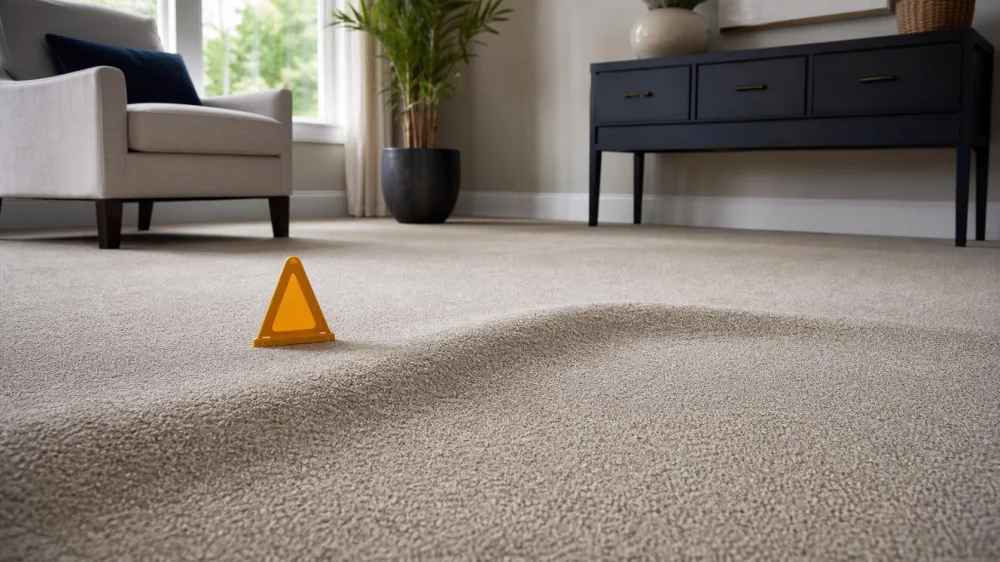
Carpet Wrinkles or Buckles? Reduce the Trip Risk and Find the Cause
On this page
- Quick answer
- Make the room safer first
- Map the wrinkles without disturbing them
- Check for moisture and humidity
- Review installation and cushion factors
- Consider furniture and rolling loads
- Build a useful evidence record
- Choose the right professional
- Understand professional restretching
- Prevent another buckle
Quick answer
Carpet wrinkles, bubbles, or buckles can create a trip hazard and accelerate wear. Keep people away from the raised area, photograph it, and note whether it appeared after installation, wet cleaning, a leak, high humidity, moving furniture, or heavy rolling traffic. Do not cut the carpet, hammer tack strips, inject adhesive, or try to stretch it with improvised tools.
If the carpet is wet or a leak is active, stop the water source when safe and contact appropriate water-damage help. If the carpet is dry, call the retailer, installer, or manufacturer and ask for an inspection. A trained installer can determine whether the installation is stretch-in or glue-down and whether professional power restretching or another repair is appropriate.

Make the room safer first
Block the wrinkled path with visible furniture or barriers without placing weight on the buckle. Reroute children, older adults, pets, and anyone with limited vision or mobility. Improve lighting and stop robot vacuums, wheeled chairs, carts, and toys from crossing the raised area.
Do not cover the wrinkle with a loose rug, tape, or mat; that can hide the hazard and create another unstable edge. If the buckle is on a stair, at an exit, or in an essential walkway, contact a professional urgently and avoid the area until it is made secure.

Allied Flooring and Design Center
East LongmeadowHampden CountyMassachusetts
55 N Main St, East Longmeadow, MA 01028, USA
Map the wrinkles without disturbing them
Look at the carpet from several angles. Record whether the issue is a long wave, a local bubble, a ridge near a seam, loose material at a wall, or broad movement across connected rooms. Note whether it changes with weather, HVAC operation, time of day, or foot traffic.
Do not lift edges or seams to investigate. Instead, mark wrinkle endpoints on a room sketch and measure their distance from walls, doors, vents, seams, and recent furniture locations. Check adjoining rooms and halls because a stretch-in installation can behave as a connected field.
Check for moisture and humidity
Look for plumbing leaks, wet baseboards, damp odors, recent flooding, overflowing appliances, roof intrusion, or water from cleaning. If electrical equipment or contaminated water is involved, keep out and use qualified emergency help. Wet carpet, cushion, and subfloor may require professional water restoration, not routine carpet restretching.
The Carpet and Rug Institute FAQ lists high humidity among possible causes of buckling. Its maintenance bulletin notes that some humidity- or wet-cleaning-related ripples may change as the carpet dries. Record indoor humidity and conditions, but do not assume drying alone has corrected underlying installation or moisture damage.
Review installation and cushion factors
Find the carpet style, backing, cushion specification, installation method, room dimensions, installation date, invoice, and warranty. Wrinkles can relate to stretching, tack strip, cushion, temperature during installation, seam layout, or manufacturer requirements. A glue-down installation requires a different diagnosis from a stretch-in carpet over cushion.
The CRI installation guidance says residential carpet should follow manufacturer instructions and the applicable installation standard, including power stretching where required to minimize wrinkling. Ask the original installer to explain the method used rather than inferring it from appearance.
Consider furniture and rolling loads
Dragging heavy furniture can shift stretch-in carpet, especially if the load pushes across a large area. Rolling office chairs, mobility devices, equipment, or repeatedly moved beds may also concentrate force. Record recent moves and whether professionals used sliders, lifts, or rolling devices.
Do not move heavy furniture again merely to test a theory. Tell the inspector what moved, in which direction, and when the wrinkle appeared. Ask whether the carpet and cushion are rated for the room’s traffic and whether a suitable chair mat or different installation system is needed.
Build a useful evidence record
Take wide photos under natural and room light, low-angle photos showing ridge height, and a video of the walking path without stepping on the buckle. Include a ruler for scale and repeat photos when weather or humidity changes. Save moisture readings only if taken with appropriate equipment and note the instrument used.
Collect contracts, room measurements, product labels, cushion details, installer credentials, cleaning receipts, leak or restoration reports, maintenance history, and previous messages. Contact the retailer before making changes if a product or workmanship warranty may apply.
Choose the right professional
Call a water-restoration professional for wet carpet, an installer or carpet repair specialist for dry stretch or seam concerns, and the retailer or manufacturer for a possible warranty claim. Describe the room size, installation method if known, wrinkle pattern, moisture history, connected rooms, furniture, and accessibility.
Ask whether the inspector follows manufacturer instructions and current residential installation standards, carries insurance, and will provide a written diagnosis and scope. Get pricing for furniture moving, seam work, transition removal, restretching, replacement, and disposal before authorizing work.
Understand professional restretching
Proper restretching is more than pushing a ridge toward a wall. The technician may need to remove furniture, release edges, open or remake doorway seams, inspect tack strip and cushion, power stretch in coordinated directions, trim excess, and resecure transitions. Connected areas may need to be addressed together.
CRI’s technical guidance identifies a power stretcher as the appropriate tool for correcting many stretch-in wrinkles. A knee kicker is a positioning tool, not a substitute for full stretching. Ask how pile, seams, pattern, baseboards, radiant heat, and transitions will be protected and whether visible effects may remain.
Prevent another buckle
Keep indoor humidity within the carpet and building recommendations, fix leaks promptly, and use a qualified cleaner who follows the carpet manufacturer’s method. Lift heavy furniture or use an appropriate professional moving plan. Do not let wheeled loads repeatedly cross carpet that is not specified for them.
After repair, photograph the flat carpet, save the work order, and follow cure or traffic restrictions. Inspect during seasonal humidity changes and after cleaning. If a ridge returns, contact the repairer promptly with before-and-after records instead of repeatedly attempting local fixes.



 Saba Rugs & Flooring5.0 (1 reviews)
 Clifford's Carpet & Water Beds4.0 (9 reviews)
 The Home Depot4.0 (1425 reviews)
 Carpets Unlimited Inc.(CUI Floors)0.0 (0 reviews)
 McDonald Flooring & Design, Inc.4.0 (7 reviews)
 The Home Depot3.0 (1253 reviews)
 Carpet Static Electricity: A Safe Troubleshooting Guide
 Carpet Wrinkles or Buckles? Reduce the Trip Risk and Find the Cause
 How to Choose Carpet That Improves Home Comfort
 Carpeting vs. Hardwood Floors: A Comparison of Style and Durability | CarpetHub
 Best Carpet Choices for Homes in Hot and Dry Climates
 Carpet Design Mistakes to Avoid in Your Home Makeover