
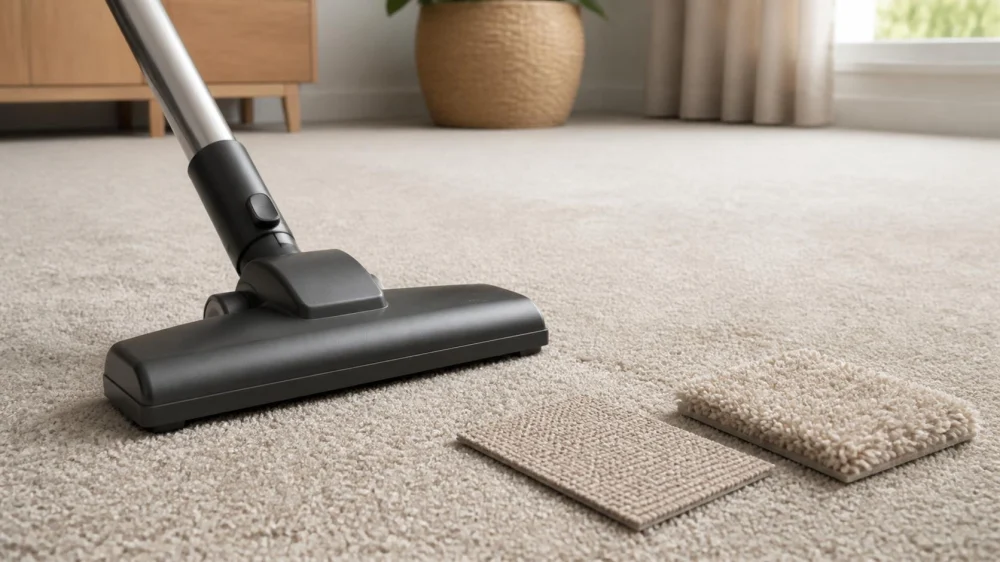
Vacuum Settings for Carpet: Suction, Brush Roll, and Pile Height
On this page
Quick answer
Match the vacuum to the carpet maker's care instructions before changing settings. Begin with the cleaning head high enough to move freely, use the lowest effective agitation and suction, and test a hidden area. Lower the head gradually only when the machine glides without pulling yarns, stalling the brush, sealing to the floor, or changing the texture.
High-pile, shag, delicate loop, handmade, or specialty carpets may require the brush roll off, a straight-suction tool, a different nozzle, or professional advice. A powerful vacuum is not automatically a compatible vacuum.

Carlos Carpet and Flooring
PhiladelphiaPhiladelphia CountyPennsylvania
515 Bainbridge St, Philadelphia, PA 19147, USA
Identify the carpet before adjusting
Find the warranty and care guide or ask the retailer or manufacturer for the exact product instructions. Note whether the surface is cut pile, loop pile, high pile, shag, wool, synthetic, patterned, or a combination. Check whether it is wall-to-wall carpet, a loose rug, or a carpet tile system.
Also identify the vacuum features: manual or automatic height adjustment, brush-roll shutoff, suction control, variable speed, floor-tool type, and bag or filter status. Do not force a setting the machine does not offer.
Connecticut Flooring Solutions
East HaddamLower Connecticut River Valley Planning RegionConnecticut
2 Deer Run, East Haddam, CT 06423, USA
Set the cleaning-head height
If the vacuum has manual height levels, start higher than you think necessary. With the machine running on the test area, lower the head one step at a time until it removes surface soil while still moving smoothly. A head set too high may barely contact the pile; too low can restrict airflow, make pushing difficult, overload the brush, or increase texture change.
Automatic height systems still need observation. If the nozzle locks onto the carpet or the motor sound changes sharply, stop and check the manual rather than repeatedly forcing it.
Choose brush roll on or off
A rotating brush can improve dry-soil removal on many conventional carpets, but it can be too aggressive for some constructions. The Carpet and Rug Institute warns that brush rollers may cause severe, irreversible texture change on some high-pile frieze or shag styles and notes that alternative vacuums without brush-roll agitation may be needed.
Turn the brush off or use the recommended straight-suction attachment when the carpet maker requires it. Keep rotating brushes away from loose fringe, exposed edges, pulled loops, and cords.
Adjust suction and airflow
More suction can help lift dry soil, but a sealed nozzle may make the machine hard to move and strain the carpet or vacuum. If the model allows it, open an airflow vent or reduce suction until the tool moves evenly while still collecting debris.
Loss of cleaning performance can also come from a full bag or bin, clogged hose, dirty filter, wrapped brush, worn belt, or blocked airway. Unplug the machine before clearing or servicing it and follow the manufacturer instructions.
Test in a low-visibility area
- Inspect the carpet for loose yarns, seams, fringe, or damage.
- Choose a small area away from the main sightline.
- Start with high clearance and low agitation.
- Make one slow forward-and-back pass.
- Check for fuzzing, pulling, distortion, unusual shedding, or colour change.
- Adjust one setting at a time.
- Stop if the result worsens or the machine strains.
Use a low-stress vacuuming technique
Remove small objects first and keep the cord behind the cleaning path. Use overlapping, controlled passes rather than rapid scrubbing. Change direction occasionally on compatible pile, but do not repeatedly grind the nozzle over a stain or snag.
Use an edge or crevice tool gently along baseboards and transitions. Support loose rugs so the nozzle does not grab an edge, and avoid vacuuming damp carpet unless the machine and situation are specifically designed for wet pickup.
Stop signs and troubleshooting
Stop immediately if the brush stalls, a belt smells hot, the machine becomes difficult to push, pile wraps around the brush, loops pull, edges lift, or texture changes. Turn off and unplug the vacuum before inspection.
If the setting that cleans well also damages or distorts the carpet, the equipment may be incompatible. Ask the carpet manufacturer, retailer, installer, or a qualified carpet-care professional for a suitable machine or attachment.
Setup checklist
- Carpet product and care guide identified.
- Vacuum manual and controls understood.
- Bag, bin, filters, hose, brush, and belt checked.
- Head starts at a high-clearance setting.
- Brush roll state matches the carpet guidance.
- Suction permits smooth movement.
- Hidden-area test shows no damage.
Important limitations
This is general U.S. carpet-care guidance, not a substitute for the carpet and vacuum manufacturers' instructions or warranty terms. Fibre, pile, backing, installation, soil, vacuum design, and prior damage change what is safe. Specialty and handmade rugs may require a trained rug-care professional.
Evidence notes
CRI technical guidance explains that vacuum compatibility affects soil removal, particle containment, and carpet damage. Its high-pile bulletin specifically cautions that brush-roll agitation can irreversibly alter some high-pile styles. CRI's current certified-equipment listings also show that machines differ in brush shutoff, height levels, filtration, and other controls, supporting product-specific selection.
FAQ
What height should I use on medium-pile carpet?
Start high and lower gradually until cleaning improves without difficult movement or texture change.
Should the brush roll always touch carpet?
No. Some carpets require reduced agitation, brush shutoff, or a straight-suction tool.
Why is the vacuum hard to push?
The head may be too low, suction may seal the nozzle, or an airway may be restricted.
Is strong suction better?
Only when the tool moves safely and the carpet maker permits it.
Can I vacuum carpet fringe?
Avoid rotating brushes on fringe; follow the rug maker's care instructions.
What if the carpet sheds during vacuuming?
Some initial shedding may occur, but sudden pulling or texture change warrants stopping and checking compatibility.
Next steps
Find the carpet care guide and vacuum manual, inspect the machine, then run a small hidden-area test starting with high clearance and low agitation. Record the setting that cleans effectively without strain or visible change.


 Lowe's Home Improvement4.0 (855 reviews)
 HomeGoods4.0 (103 reviews)
 Family Carpets of New Jersey3.0 (5 reviews)
 Fashion Floor Carpet Galleries4.0 (20 reviews)
 Vincent J Fernandez Oriental Rugs5.0 (1 reviews)
 Campbell's Carpet & Service4.0 (136 reviews)
 Best Carpet Cleaning Products for Tough Stains: Effective Solutions for a Clean Home
 Eco-Friendly Carpets That Are Both Sustainable and Stylish
 How to Make Your Carpet Look Brand New Again
 Is Carpet a Good Choice for Outdoor Spaces?
 How to Fix Gaps Between Carpet and Walls After Installation
 How to Clean Carpet After Renovations or Remodeling Projects