
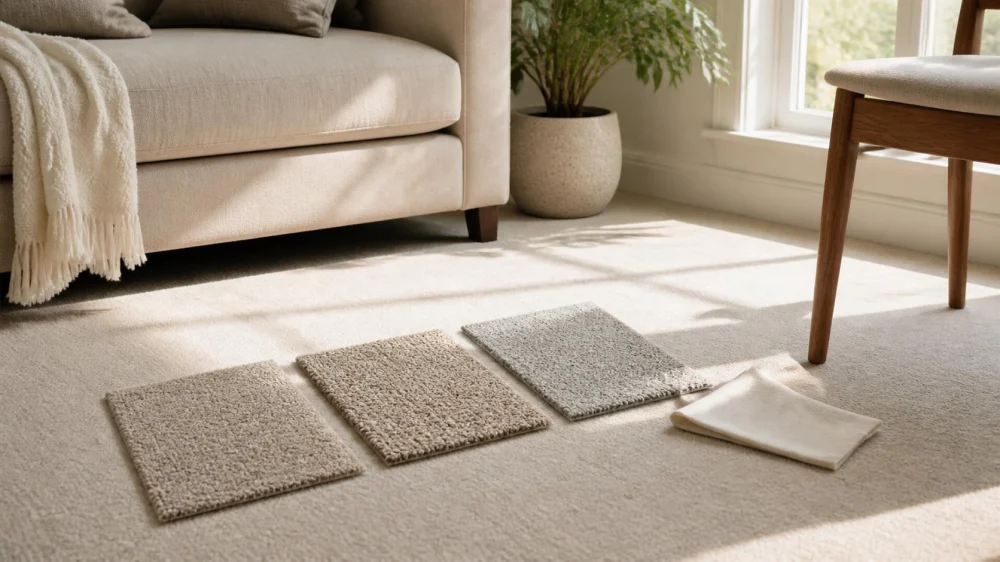
Test Carpet Samples at Home: Light, Traffic, and Furniture
Table of contents
Quick answer: Bring several large carpet samples into the actual room, then view them in daylight and artificial light over at least a full day. Compare each sample with walls, furniture, and nearby flooring. Gently press and walk on samples only as the retailer allows, record what changes, and confirm the final product details before ordering.

Why home testing matters
A carpet that looks balanced under showroom lighting can appear warmer, cooler, lighter, or more textured at home. Window direction, lamp color, wall paint, and surrounding materials influence how the eye reads a sample. Small swatches also hide the effect of a broad installed surface. Home testing will not reproduce a finished room, but it is more useful than memory.
Decide what the room needs before judging color alone. A busy family room may prioritize cleanability and pile recovery, while a bedroom may place more weight on softness. Write down those priorities so an attractive sample does not distract from practical requirements.

Build a useful sample set
Ask the carpet retailer for the largest samples available and take home at least three plausible choices. Include neighboring colors or textures rather than unrelated options. Label them with removable notes placed on the backing, keeping all product names and codes for the final order.
- Confirm the fiber, construction, pile height, color, and product line for every sample.
- Ask whether the sample may be walked on, bent, vacuumed, or tested with water.
- Keep food, pets, shoes, and cleaning chemicals away if samples must be returned.
- Compare the proposed carpet pad separately; a loose sample does not show the full installed feel.
Check color through the day
Place samples flat in the planned room, not on a table. Look at them in morning, midday, and evening light, then switch on the lamps normally used in the space. Move the samples between bright and shaded areas because one location can exaggerate a difference.
View from the doorway as well as up close. Rotate each sample 180 degrees; directional pile can reflect light differently and create a lighter or darker appearance. Take photos only as notes. Phone exposure and screen settings can distort color, so decide with the physical sample.
Test texture and recovery
With the retailer's permission, press a clean hand into the pile, place a clean chair leg on it briefly, and walk across it in clean socks. Observe whether the pile springs back and whether footprints or shading are acceptable to you. Do not assume a short test predicts years of wear.
Rub the surface gently with a clean white cloth to notice loose fibers or color transfer, but stop if the retailer prohibits testing. Never apply stain remover, bleach, heat, or a wet household remedy to a borrowed sample. Ask for a separate test piece if spill resistance is important.
Compare with the room
Place each sample beside the wall, baseboard, sofa, curtains, and any hard-floor transition. Look for harmony rather than an exact match. A slightly varied palette often looks more natural and is easier to maintain than several almost-matching beige or gray tones.
Check practical boundaries too. Open the door over the sample, note the transition height, and consider floor vents, stairs, and rolling furniture. The installer must confirm clearances and transition details; the loose sample is only an early warning.
Record and confirm
Create a simple scorecard with color in daylight, color at night, texture, visible tracking, compatibility, maintenance, price, and warranty requirements. Score each factor consistently, then note any question that requires a retailer answer. Keep a photo of the sample label rather than relying on color names.
Before paying, ask whether the ordered carpet will come from one dye lot and how the retailer handles reasonable variation. Confirm measured quantity, pad specification, seam plan, installation scope, furniture moving, removal, transitions, warranty registration, and leftover material in writing.
Limitations and cautions
A sample cannot perfectly predict an entire installation. Manufacturing variation, seam placement, pile direction, lighting across a large area, pad, subfloor, and installation technique can change the result. Online images and room visualizers are planning aids, not color guarantees. If household members have sensitivity concerns, ask the retailer for product documentation and discuss appropriate ventilation before installation.
Frequently asked questions
How long should carpet samples stay in the room?
A full day is a useful minimum because it captures daylight and nighttime lighting. A weekend can be better when the retailer's loan period allows it.
Should I choose the darkest sample to hide dirt?
Not automatically. Very dark carpet may show lint, dust, and light-colored debris. Mid-tones and varied textures can disguise some everyday soil, but cleaning requirements still depend on the specific product.
Can I test a sample with a household cleaner?
Only with explicit permission and the manufacturer's care instructions. Use a separate approved piece when possible, because an improvised test can damage a loaned sample and may not represent installed performance.
Next steps
- Borrow three large, clearly identified samples.
- Compare them in every normal lighting condition.
- Run only retailer-approved texture or recovery checks.
- Score the options against the room's real priorities.
- Confirm the exact product, dye lot, pad, scope, and warranty before ordering.



 National Floor Center4.0 (38 reviews)
 North Haven Tile Carpet One Floor & Home4.0 (22 reviews)
 HomeGoods4.0 (345 reviews)
 American Flooring Direct4.0 (10 reviews)
 Lucas carpet5.0 (8 reviews)
 RFW Floor Covering3.0 (6 reviews)
 How to Install Carpet Like a Pro: A Step-by-Step Guide for Beginners
 How to Remove Paint from Carpet Without Ruining It: Proven Methods
 How to Maintain Your Carpet in a Busy Household
 Using Carpets to Define Zones in Open Floor Plans
 How to Find the Best Deals on High-Quality Carpets
 How to Choose the Right Carpet for Your Home Office